Stop Wasting Time SVG: A Designer’s Review
As a designer who has spent countless hours digitizing and testing files for real-world production, I have learned that not every digital asset translates well to thread. We often browse marketplaces looking for the next big hit for our Crafts inventory, but the gap between a crisp vector on a screen and a stitched finished product can be wide. Today, I am evaluating the Stop Wasting Time SVG Cut File to see if it holds up under the needle. This is not just about whether the file opens correctly; it is about whether it creates value for your craft business and satisfies the end customer.
First Impressions and Visual Personality
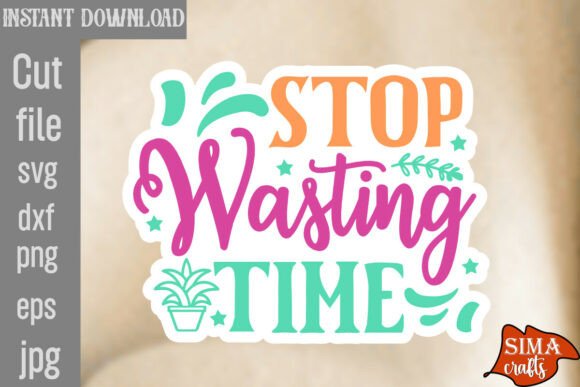
When I first loaded the Stop Wasting Time SVG Cut File into my design software, the immediate impression was one of bold urgency. The typography is assertive, likely featuring strong, clean lines that demand attention. In the world of Graphics, this kind of statement piece works because it conveys a mood instantly. For embroidery, however, mood must be balanced with mechanics. The design feels modern and slightly rebellious, making it a natural fit for contemporary apparel rather than traditional heirloom pieces. It speaks to a demographic that values efficiency and humor, which is a lucrative niche for Etsy sellers and boutique owners.
The layout appears straightforward, which is often a blessing in disguise for stitchers. Complex, overly detailed vectors can become nightmares when converted to thread, resulting in bird’s nests and broken needles. This design’s relative simplicity suggests it was created with cutters in mind, but we need to assess how those same lines behave when filled with satin or fill stitches. The visual personality is direct, making it an excellent candidate for items where the message is the primary selling point.
Real-World Application: The Custom Tote Scenario
To truly test a file, I imagine it in a specific production scenario. Let’s say I am preparing a batch of custom canvas tote bags for a local co-working space. They want merchandise that reflects their productivity-focused culture. The Stop Wasting Time SVG Cut File seems perfect for this. I visualize the design centered on the front panel of a heavy-duty cotton tote.
In this context, the design needs to be large enough to be legible from a distance but compact enough to fit within a standard hoop. If I were stitching this on a sweatshirt, the placement would shift to the left chest or across the upper back. The bold nature of the text means it can withstand the texture of terry cloth or fleece without getting lost. For a personalized gift, such as a apron for a busy chef or a patch for a student’s backpack, the clarity of the message adds immediate emotional resonance. Customers do not just buy the item; they buy the attitude the design projects.
Technical Performance and Stitching Considerations
Here is where the rubber meets the road. The product description notes that this is a DIGITAL DOWNLOAD ONLY containing SVG, DXF, EPS, and PNG files. It is crucial to understand that these are primarily cut files for machines like Cricut or Silhouette, not native embroidery formats like PES or DST. As an experienced reviewer, I must advise you that using these files for embroidery requires an additional step: digitizing. You will need to import the SVG or EPS into embroidery software to create the stitch path.
When converting this type of typographic design, pay close attention to stitch density. Large block letters can become stiff and board-like if over-filled. I recommend using a combination of satin stitches for smaller elements and fill stitches for larger areas, ensuring you include underlay stitches to stabilize the fabric. If you are creating an embroidered patch, the dense border will help contain the edges, but for direct-to-garment work on a tote bag design or sweatshirt embroidery, you must account for fabric stretch.
Be cautious with small details. If the font has intricate serifs or tight spacing, these may merge during stitching. Always run a test on scrap fabric identical to your final material. Check your thread colors against the fabric background. High contrast is key for readability. A dark thread on a dark fabric will render the message invisible, defeating the purpose of the design. Use a proper stabilizer—cut-away for knits and tear-away for wovens—to prevent puckering, which can distort the text and make the handmade product look amateurish.
Navigating Fabric and Hoop Constraints
Not every surface is suitable for this design. While it works beautifully on flat, stable fabrics like cotton canvas or denim, curved surfaces like caps present a challenge. The rigid nature of bold text can cause distortion on the curved panel of a hat. If you attempt cap embroidery, ensure you use a cap frame and appropriate stabilizers to maintain shape. Similarly, avoid placing this design on highly textured fabrics like thick chenille or loose-weave linens unless you use a topping sheet, as the stitches may sink into the fabric texture.
Hoop size is another critical factor. Ensure the design fits comfortably within your machine’s maximum hoop area with room for stabilization. If you are scaling the design down for a baby item, such as a onesie, verify that the text remains legible. Tiny lettering can become illegible blobs of thread. For baby embroidery, consider simplifying the design or increasing the size to maintain clarity. Always check the license terms before selling. While the file includes commercial-use-friendly formats for cutting, confirm your rights when converting and selling the embroidered design assets.
Enhancing Brand Value and Customer Trust
Using a well-chosen design like Stop Wasting Time SVG Cut File can significantly boost your brand’s perceived value. It shows that you understand current trends and can deliver products that resonate emotionally with buyers. For small shop product lines, consistency is key. If this design fits your brand’s voice, use it across multiple items—towels, pillows, and apparel—to create a cohesive collection. This builds recognition and trust.
When listing these items on platforms like Etsy, use high-quality photos that show the texture of the stitches. A printable mockup can help visualize the product, but real photos of the stitched item convert better. Highlight the durability and quality of your stitching in your descriptions. Customers appreciate knowing that a custom apparel item is made with care and technical precision. By treating the digital file as a starting point for craftsmanship rather than a final product, you elevate the perceived value of your work.
Final Verdict for Designers and Makers
The Stop Wasting Time SVG Cut File is a versatile asset for creators who understand the translation from vector to thread. It offers a strong visual statement that appeals to modern consumers. However, its success depends entirely on your technical execution. Respect the materials, test your digitizing settings, and choose the right applications. Whether you are creating holiday embroidery gifts or stocking your online store with commercial embroidery ready goods, this design can be a powerful tool in your arsenal. Just remember: the file is the blueprint, but your skill is what builds the house. Take the time to get it right, and you will stop wasting time on reworks and start building a reputation for quality.