Reviewing the Never Ever Give Up SVG Cut File
As a designer who spends half my life digitizing motifs and the other half pulling thread through fabric, I have learned that not every graphic translates well into stitch. We often browse marketplaces looking for that perfect machine embroidery design, only to realize later that the lines are too thin, the details too dense, or the spacing awkward for a standard hoop. That is why I took a close, practical look at the Never Ever Give Up SVG Cut File. This is not just about whether the file opens correctly; it is about whether it holds up when you are trying to run a profitable craft business or create a meaningful personalized gift.
First Impressions: Mood and Visual Personality
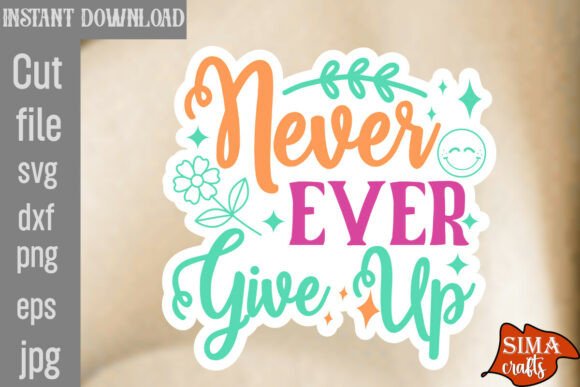
The phrase "Never Ever Give Up" carries a heavy emotional weight. It is motivational, resilient, and bold. When I first loaded the vector files to inspect the paths, I was looking for clean nodes and balanced kerning. In the world of Graphics and Crafts, typography is king. If the letters are uneven, the stitched result will look amateurish regardless of how good your tension settings are.
This design feels structured yet approachable. It does not rely on overly ornate serifs that might cause thread breaks or bird nests in tight corners. Instead, it leans toward a modern, sturdy aesthetic. For an embroidery designer, this is a relief. It suggests that the final embroidery project will read clearly from a distance, which is crucial for items like tote bags or sweatshirts where the design needs to make an immediate impact. The mood is empowering, making it a natural fit for gym gear, student accessories, or recovery-themed support items.
Real-World Application: The Sweatshirt Test
To truly evaluate a design, you have to imagine it on a product. I visualized this specific digital embroidery file placed on the left chest of a heavyweight cotton sweatshirt. This is a staple item for many Etsy sellers and small shop owners. The width of the text seemed appropriate for a standard 4x4 or 5x7 hoop, allowing for a substantial presence without overwhelming the garment.
In this scenario, the clarity of the SVG File for Cricut and the DXF File for Silhouette becomes relevant if you are creating hybrid products. For instance, you might use the SVG to cut a heat-transfer vinyl layer to combine with stitching, or use the PNG File Transparent Background, 300 Dpi to create high-quality printable mockup images for your online store. The inclusion of the EPS File Vector is a significant bonus for designers who need to scale the artwork for large-format printing or modify the shape before digitizing it for machine use.
However, since this is a DIGITAL DOWNLOAD ONLY package containing cut files and vectors, not necessarily a pre-digitized stitch file, the responsibility falls on you, the creator, to ensure the digitization matches the fabric. If you are converting this vector into a stitch file, pay attention to the stitch density. Motivational quotes often look best with a combination of satin stitch borders and a light fill stitch interior, or perhaps a clean running stitch for a minimalist, hand-drawn look.
Navigating Fabric and Hoop Constraints
While the design is strong, there are areas where caution is necessary. Embroidery is unforgiving on certain surfaces. If you plan to use this on a curved surface like a cap, you must account for the distortion. The letter spacing in "Never Ever Give Up" needs to be wide enough so that the pull of the thread does not cause the letters to touch or distort on the curved brim.
Similarly, consider the fabric texture. On a textured towel or a rough canvas tote bag design, fine details can get lost. I recommend testing the design on scrap fabric first. Check how the thread colors contrast against the material. A dark thread on a dark fabric will vanish, while a light thread on a sheer fabric might show the stabilizer underneath. Always use the proper stabilizer—cut-away for stretchy fabrics like jersey knits, and tear-away for stable wovens like cotton aprons or pillow covers.
Be mindful of hoop size limitations. If you are working with a small 4x4 hoop, you may need to split the design or reduce the font size significantly. Reducing size too much can lead to tiny lettering that becomes illegible once stitched. Always inspect small details at 100% zoom on your screen before committing to the machine.
Commercial Value and Brand Consistency
For commercial embroidery professionals and small shop product creators, consistency is key. This design offers a versatile asset that can be adapted across various product lines. Imagine using it on a series of baby embroidery items for new parents facing challenges, or on holiday embroidery gifts for graduates. The message is timeless.
Using the included PNG File allows you to maintain brand consistency across your social media and website. You can overlay the text on lifestyle photos to create engaging content without needing to stitch every single sample physically. This saves time and materials while still showcasing the potential of the finished product.
Customer trust is built on quality. A clean, well-spaced design signals professionalism. If the underlying vector is messy, your digitized version will likely suffer from jumps and trims that look sloppy. Since this package provides the core vector assets, you have the control to ensure the final applique design or stitched version meets your high standards. This level of control is essential for maintaining a reputable handmade product line.
Practical Designer Notes for Best Results
Before you list this as a new item in your store or stitch it for a client, keep these practical steps in mind:
- Test on Scrap: Always run a test stitch-out on the same type of fabric you intend to use for the final item. This reveals issues with stitch density and registration.
- Check Licensing: While the file includes multiple formats, confirm the licensing terms for commercial use. Ensure you are allowed to sell physical items made with designs derived from these vectors.
- Contrast Check: View the design in black and white. If it loses definition in monochrome, it may lack the necessary contrast for certain thread colors combinations.
- Format Selection: Use the SVG File for Cricut if you are cutting heat transfer vinyl to pair with embroidery. Use the DXF File for Silhouette for similar cutting applications. Use the EPS File Vector if you are resizing the design significantly for large prints or re-digitizing.
- Fabric Suitability: Avoid using complex, dense versions of this text on thin or stretchy fabrics without adequate stabilization. It can cause puckering.
The Never Ever Give Up SVG Cut File is a solid addition to your library of design assets. It bridges the gap between digital precision and tactile craft. Whether you are creating a rugged embroidered patch for a backpack or a delicate custom apparel piece for a boutique, this design provides the structural integrity needed for professional results. Just remember that the file is the starting point; your skill in digitizing, hooping, and stitching is what brings the message to life.